
Introduction
Pharmaceutical process development focuses on transforming a laboratory or pilot-scale manufacturing approach into a controlled, reproducible, and scalable production process.
A well-developed pharmaceutical process should consistently deliver a product that meets predefined quality requirements. Achieving this objective requires an understanding of the relationship between process parameters, material properties, equipment, and critical quality attributes.
Understanding the Manufacturing Process
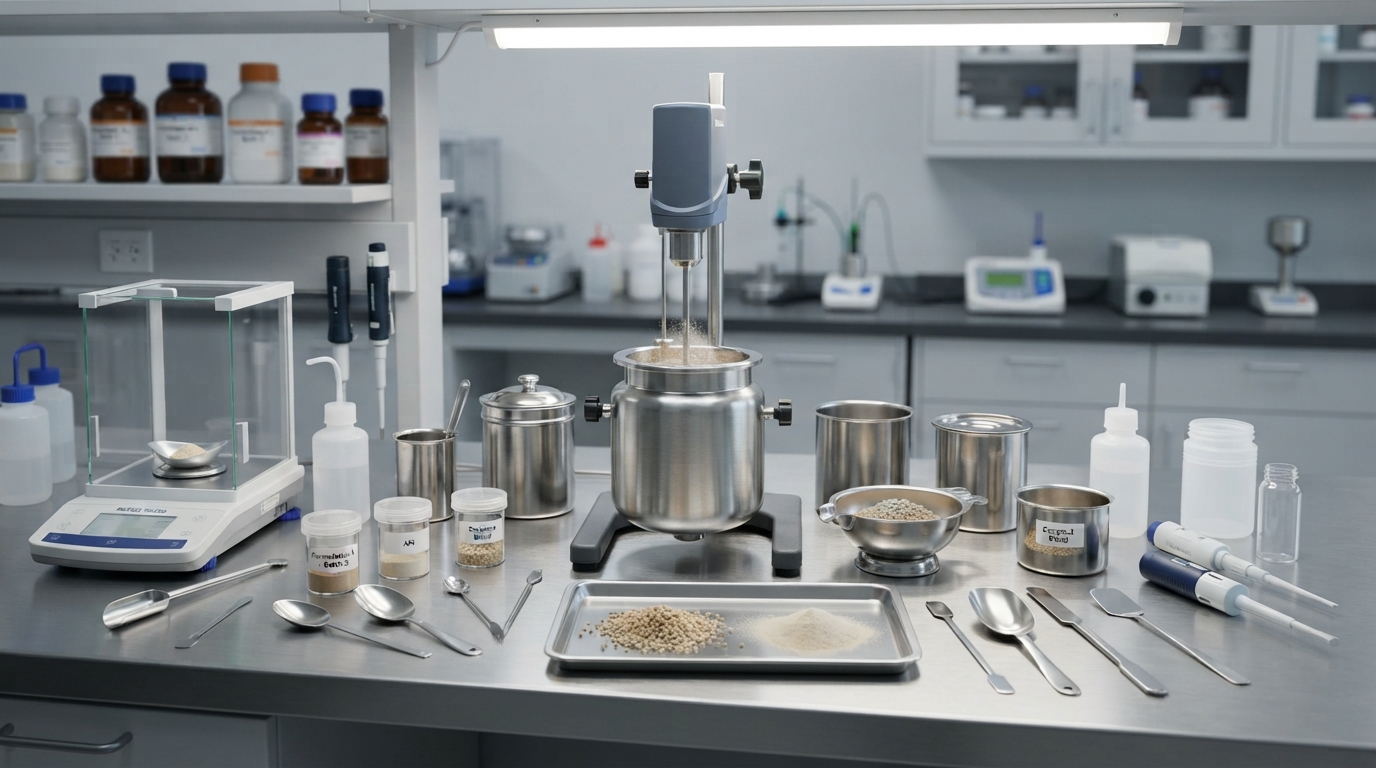
A pharmaceutical manufacturing process consists of multiple interconnected operations. Depending on the dosage form, these may include dispensing, blending, granulation, drying, milling, compression, coating, filling, or other unit operations.
Each operation can influence subsequent processing steps and ultimately affect product quality.
Process development therefore begins with identifying the important process variables and understanding how they influence product performance.
Critical Process Parameters
Critical Process Parameters (CPPs) are process parameters whose variability can affect critical quality attributes.
Examples may include mixing time, granulation endpoint, drying temperature, spray rate, compression force, coating parameters, or other process-specific variables.
The identification and control of relevant CPPs are important for establishing a robust manufacturing process.
Process Optimization
Process optimization involves systematically evaluating process variables and identifying operating conditions that provide consistent and acceptable performance.
Rather than relying solely on trial-and-error experimentation, structured development approaches can be used to understand interactions between variables and establish an appropriate operating range.
Process optimization may improve reproducibility, reduce variability, and support more efficient manufacturing.
Scale-Up
One of the major challenges in pharmaceutical process development is transferring a process from laboratory or pilot scale to larger manufacturing equipment.
Differences in equipment geometry, mixing, heat transfer, mass transfer, residence time, and material handling can influence process behavior.
Therefore, scale-up should be based on process understanding and relevant engineering principles.
Process Robustness
A robust process should tolerate reasonable variation in input materials and operating conditions while maintaining acceptable product quality.
Process robustness is particularly important for commercial manufacturing because routine production inevitably involves some degree of variability.
A well-understood process provides a stronger foundation for process validation and continued process verification.
Conclusion
Pharmaceutical process development connects formulation and laboratory development with industrial manufacturing.
Through systematic process characterization, optimization, scale-up, and control of critical parameters, developers can establish manufacturing processes that are more reproducible, scalable, and suitable for routine production.